
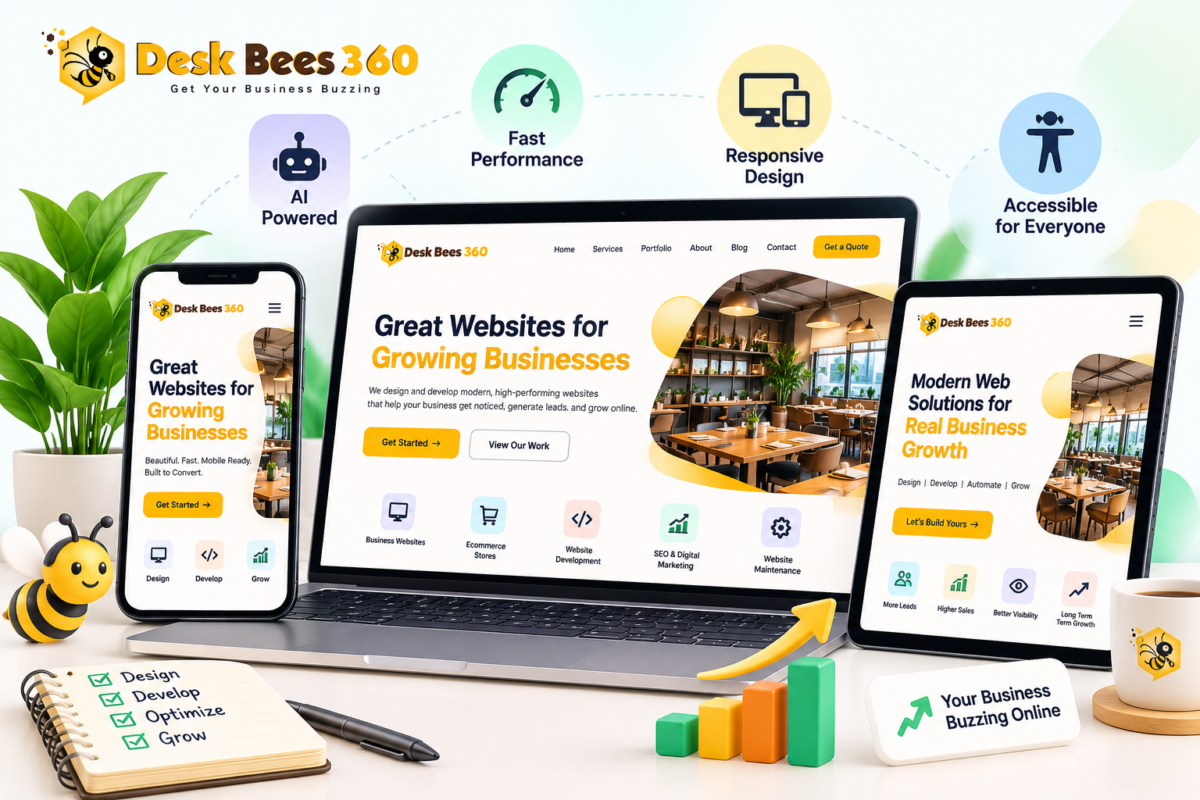
Your website is more than your digital business card. In 2026, it is your storefront, salesperson, customer support channel, and brand experience—all in one place.
Website design is evolving rapidly. Artificial intelligence, changing customer expectations, mobile-first experiences, and new interactive technologies are transforming how businesses build their online presence.
Today’s customers expect websites to load quickly, look professional, work seamlessly on mobile devices, and make finding information effortless. At the same time, businesses need websites that attract visitors, generate leads, support sales, and communicate credibility.
According to Figma’s 2026 web design trends guide, designers are exploring immersive 3D experiences, bold typography, expressive colour palettes, motion design, and AI-powered interactions. Meanwhile, Webflow’s 2026 State of the Website report highlights the growing importance of AI-driven search, website governance, and modern website management.
So, what should businesses focus on when designing a website in 2026?
Let’s explore the top website design trends shaping the digital landscape and how your business can benefit from them.
1. AI-Powered Websites and Personalised User Experiences
Artificial intelligence is changing how websites interact with visitors.
Instead of presenting the same static experience to everyone, businesses can use AI to provide more relevant information, recommendations, and assistance based on a visitor’s needs.
For example, an ecommerce website can recommend products based on browsing behaviour. A service business can use an AI assistant to help visitors identify the right service. A B2B website can guide potential customers towards relevant solutions based on their industry or requirements.
How AI is changing website design
- AI-powered chatbots that answer common questions.
- Intelligent product and service recommendations.
- Personalised content based on visitor preferences.
- Automated lead qualification and enquiry routing.
- AI-assisted search and navigation.
- Automated responses to frequently asked questions.
Example: Imagine a visitor landing on a website development agency’s website. An AI assistant could ask whether they need an ecommerce website, a business website, or a custom web application and guide them towards the relevant service page.
This reduces the effort required to find information and can make the enquiry process more efficient.
What businesses should do
Start with a clearly defined problem rather than adding AI simply because it is popular.
A useful chatbot, intelligent search feature, or automated enquiry workflow can provide real value. An intrusive chatbot that interrupts visitors without helping them can have the opposite effect.
At DeskBees, we recommend treating AI as a practical extension of your website’s functionality—not a substitute for good design, accurate content, or human support.
2. Mobile-First Website Design Is Essential
Mobile-first design remains one of the most important principles in modern website development.
Many customers discover businesses through mobile searches, social media links, messaging apps, and online advertisements. If a website is difficult to use on a smartphone, potential customers may leave before contacting the business.
Mobile-first design means planning the experience for smaller screens and limited interaction space before adapting it for larger displays.
Key elements of mobile-first design
- Responsive layouts that adapt to different screen sizes.
- Readable typography without unnecessary zooming.
- Touch-friendly buttons and navigation.
- Optimised images and lightweight page components.
- Short, easy-to-complete enquiry forms.
- Clear contact information and calls to action.
- Fast access to maps, menus, and booking options.
For local businesses, convenient actions are particularly important.
A restaurant visitor should be able to view the menu, find directions, and contact the business without navigating through several pages. A service business should make requesting a quotation straightforward.
What businesses should do
Test your website on actual mobile devices, not just a desktop browser resized to a smaller width.
Check the complete customer journey, from landing on the homepage to completing a purchase, submitting an enquiry, or contacting your business.
The goal is simple: make it easy for mobile visitors to take the next step.
3. Minimalist Design With Purpose
Minimalism continues to influence modern website design, but effective minimalism is about more than empty space and simple colours.
In 2026, the emphasis is on removing unnecessary complexity while making the remaining elements more meaningful.
A well-designed minimalist website helps visitors understand what a business offers, why it matters, and what they should do next.
Characteristics of effective minimalist websites
- Clear visual hierarchy.
- Generous whitespace.
- Simple and predictable navigation.
- Concise headlines and supporting copy.
- Limited, purposeful colour palettes.
- Consistent spacing and alignment.
- Prominent calls to action.
For example, a professional services website does not need multiple animated banners, competing pop-ups, and long blocks of text above the fold.
A strong headline, a clear explanation of the service, relevant proof of credibility, and a prominent enquiry button may communicate the value much more effectively.
Why this trend matters
Visitors often arrive with a specific objective. They want to understand a product, compare services, find pricing information, or contact a company.
Unnecessary visual elements increase the effort required to accomplish these tasks.
Minimalist design helps businesses focus attention on the information and actions that matter most.
Remember: Minimalism should improve clarity, not remove information customers need to make decisions.
4. Bold Typography and Distinctive Brand Identity
As more businesses use similar website builders, templates, and AI-assisted design tools, creating a recognisable brand experience is becoming increasingly important.
Typography is one of the most effective ways to establish that identity.
Large headlines, distinctive font combinations, carefully controlled spacing, and expressive text treatments can make a website more memorable without requiring complicated graphics.
Typography trends to watch
- Oversized headlines that communicate a clear message.
- Bold geometric sans-serif fonts.
- Strong contrast between headings and body text.
- Editorial-style typography for storytelling.
- Carefully selected accent fonts.
- Large text paired with simple supporting visuals.
For example, a creative agency might use oversized headlines and unconventional layouts to communicate originality. A financial services company might choose restrained typography to convey professionalism and trust.
The appropriate choice depends on the audience and brand positioning.
What businesses should do
Establish a consistent typography system before designing individual pages.
Choose fonts for headings, body text, buttons, and supporting labels. Define sizes and line spacing for mobile and desktop layouts.
Avoid using too many font families or reducing readability simply to create a dramatic visual effect.
Your typography should make your brand recognisable while keeping information easy to read.
5. Subtle Animations and Meaningful Micro-Interactions
Modern websites are becoming more interactive, but the best animation is often the kind visitors barely notice consciously.
Micro-interactions provide visual feedback when someone performs an action. They can make interfaces feel responsive and help users understand what is happening.
Examples of useful micro-interactions
- A button changing appearance when hovered over.
- A form displaying a clear success message after submission.
- A shopping cart updating when an item is added.
- A subtle transition between interface states.
- A progress indicator during a multi-step form.
- An accordion expanding when a visitor selects a question.
- A navigation menu opening smoothly.
More expressive websites may also use scroll-triggered animations, animated illustrations, or visual transitions to support storytelling.
However, animation should serve a purpose.
Excessive motion can distract visitors, make navigation frustrating, create accessibility problems, and slow down a website when implemented inefficiently.
What businesses should do
Use animation to communicate state changes, guide attention, or explain a product.
Keep interactions short and predictable. Respect reduced-motion preferences and ensure important content remains accessible when animations are disabled.
A website should feel responsive because it is well engineered—not because everything on the screen is moving.
6. AI Search Visibility and Answer-Ready Website Content
Search behaviour is evolving.
Alongside traditional search engine results, people increasingly use AI-powered tools to discover businesses, compare products, and find answers to specific questions.
This creates a new consideration for website owners: their content needs to be useful to people and understandable to search engines and AI-powered discovery systems.
Webflow’s 2026 State of the Website report identifies optimisation for AI-driven search and summaries as a priority for many marketing leaders.
This does not mean abandoning traditional SEO. It means strengthening the foundations of discoverability.
How to make your website easier to understand
Use descriptive headings. Organise pages around clear topics, with logical H1, H2, and H3 headings.
Answer real customer questions. Explain pricing factors, processes, product differences, service areas, and common concerns.
Publish useful original content. Provide detailed service pages, practical guides, case studies, and accurate business information.
Use semantic HTML. Structure content so that browsers and automated systems can understand the relationships between headings, paragraphs, navigation, and other elements.
Implement relevant structured data. Where appropriate, use supported schema types to describe products, services, organisations, and other entities accurately.
Maintain consistent business information. Keep your business name, contact details, service descriptions, and location information accurate across relevant platforms.
Build a strong internal linking structure. Connect related articles, service pages, and resources so visitors can explore a topic in greater depth.
What businesses should do
Start by improving the quality and organisation of your website content.
Avoid publishing large volumes of generic AI-generated articles simply to target keywords. Prioritise useful information, genuine expertise, accurate claims, and content that answers the questions your customers actually ask.
AI visibility is not guaranteed by using a particular heading format or adding structured data. These practices help clarify content, but discovery depends on many factors beyond website design.
7. Performance-First Design and Faster Loading Websites
A visually impressive website is not successful if visitors must wait too long for it to load.
Website performance affects usability, particularly for mobile visitors using slower connections or less powerful devices.
Performance-first design treats speed as a requirement from the beginning rather than something developers attempt to fix after launch.
Key website performance practices
- Compress and properly size images.
- Use modern image formats where appropriate.
- Load images efficiently, including lazy-loading suitable below-the-fold content.
- Minimise unnecessary JavaScript and CSS.
- Avoid excessive third-party scripts.
- Use browser caching effectively.
- Select suitable hosting infrastructure.
- Reduce unnecessary redirects and network requests.
- Monitor real-world user performance.
Three important metrics are Google’s Core Web Vitals:
| Metric | What it measures | Good target |
|---|---|---|
| Largest Contentful Paint (LCP) | How quickly the main content appears | 2.5 seconds or less |
| Interaction to Next Paint (INP) | How quickly the page responds to user interactions | 200 milliseconds or less |
| Cumulative Layout Shift (CLS) | How much the layout unexpectedly shifts | 0.1 or less |
These targets are assessed at the 75th percentile of page visits, with mobile and desktop experiences evaluated separately.
Why performance matters
A fast website allows visitors to access information with less waiting and fewer interruptions.
It can support a better user experience and contribute to stronger conversion outcomes. Core Web Vitals are also used by Google within its broader page experience and ranking systems, although good scores alone do not guarantee higher search rankings.
What businesses should do
Measure performance before and after launch using tools such as Google PageSpeed Insights.
Test important pages individually, especially the homepage, service pages, product pages, and checkout.
Avoid adding heavy visual effects or third-party tools without considering their impact on loading and interaction performance.
8. Accessibility-First and Inclusive Web Design
A professional website should be usable by as many people as reasonably possible, including people with visual, auditory, motor, or cognitive disabilities.
Accessibility is increasingly being considered an essential part of design quality rather than a feature added at the end of development.
Important accessibility practices
- Provide sufficient text and interface contrast.
- Add meaningful alternative text to informative images.
- Use descriptive links and button labels.
- Ensure the website can be navigated using a keyboard.
- Make focus indicators visible.
- Label forms clearly and explain validation errors.
- Use semantic HTML and appropriate heading structures.
- Provide captions or transcripts for relevant multimedia.
- Avoid communicating important information through colour alone.
- Support browser zoom and text resizing.
Accessibility guidelines such as the Web Content Accessibility Guidelines (WCAG) provide a recognised framework for evaluating and improving websites.
What businesses should do
Include accessibility checks in the design, development, and testing process.
Automated accessibility tools can identify many common problems, but they do not detect everything. Keyboard testing, screen-reader testing, and human evaluation remain important.
Accessible design often improves usability for everyone—not just people with disabilities.
For example, clearly labelled forms, readable typography, and predictable navigation benefit visitors across a wide range of devices and circumstances.
9. 3D Visuals, Immersive Experiences, and Interactive Product Demonstrations
Three-dimensional graphics and interactive experiences are becoming more accessible to website designers.
Instead of relying entirely on static images, businesses can use 3D models, interactive product previews, virtual tours, and other visual tools to help customers understand what they are buying.
Figma’s 2026 web design trends guide highlights immersive 3D elements and interactive experiences as notable directions in web design.
Where immersive design can be useful
Ecommerce: Allow customers to inspect a product from multiple angles or explore customisation options.
Interior design: Show how furniture or decorative products might look in different settings.
Real estate: Provide virtual property tours.
Hospitality: Let potential guests explore a restaurant, hotel, or event venue through a virtual tour.
Manufacturing: Demonstrate equipment, components, or complex products through interactive models.
Education: Explain complicated concepts through visual simulations.
For a local restaurant, for example, a Google Street View 360° virtual tour can help potential customers explore the dining space before visiting.
For an ecommerce business, an interactive product model may communicate details that a single photograph cannot.
What businesses should do
Use immersive elements where they genuinely help customers understand a product, service, or physical location.
Consider the additional development cost, mobile compatibility, loading performance, and accessibility requirements.
A simple, well-optimised photograph may be more effective than a complex 3D experience for many business websites.
10. Vibrant Colours, Gradients, and Expressive Visual Design
Although minimalist layouts remain popular, many brands are exploring more expressive visual identities.
Bold colours, gradient backgrounds, layered illustrations, oversized typography, and playful graphic elements can help businesses differentiate themselves in competitive markets.
Figma’s 2026 trend overview identifies vibrant colour palettes and maximalist visual approaches among the directions designers are exploring.
How businesses are using expressive design
- Gradient backgrounds for visual depth.
- Contrasting accent colours to highlight important actions.
- Custom illustrations that communicate brand personality.
- Layered graphics and overlapping visual elements.
- Oversized typography for stronger visual hierarchy.
- Distinctive colour systems across website sections.
- Playful graphics for lifestyle and consumer brands.
Which businesses can benefit?
Creative agencies, lifestyle brands, fashion businesses, cafes, restaurants, entertainment companies, and consumer startups may benefit from more expressive visual styles.
Professional services, financial businesses, and industrial companies may prefer a more restrained visual language.
The right approach depends on what customers expect from the brand.
What businesses should do
Develop a coherent visual system rather than combining every popular design effect.
Use colour to reinforce brand recognition, guide attention, and distinguish important information. Maintain readable contrast and ensure buttons remain recognisable as interactive elements.
A memorable website does not need to be visually loud. It needs to look and feel appropriate for its audience.
11. Conversion-Focused Landing Pages and Clear Calls to Action
Website design is not only about appearance. It should also help businesses achieve measurable objectives.
For many companies, these objectives include generating enquiries, booking appointments, selling products, collecting qualified leads, or encouraging visitors to contact the business.
A conversion-focused website makes these actions easy to understand and complete.
Elements of a high-performing landing page
A clear headline: Explain the main benefit immediately.
Relevant supporting content: Describe what the business offers and whom it serves.
Credibility indicators: Include genuine testimonials, case studies, qualifications, or customer reviews where appropriate.
A prominent call to action: Tell visitors what to do next.
A simple enquiry form: Request only the information necessary for the next step.
Relevant visuals: Use images that help visitors understand the service or product.
Answers to common objections: Address questions about pricing, delivery, timelines, support, or the buying process.
Example: A local service business
A website offering website design services could include:
- A headline explaining the business’s value proposition.
- Examples of completed projects.
- A clear list of services.
- An explanation of the project process.
- Genuine client testimonials.
- A quotation request form.
- A direct contact option.
This gives visitors enough context to evaluate the business before initiating a conversation.
What businesses should do
Track meaningful actions, such as completed forms, qualified enquiries, purchases, and bookings.
Use analytics and controlled experiments where appropriate to identify friction in the customer journey.
Do not assume that a visually attractive page automatically converts well. Conversion performance depends on the offer, audience, pricing, credibility, usability, and many other factors.
12. Conversational Interfaces and Smarter Customer Support
Customers increasingly expect convenient ways to ask questions and receive assistance.
Conversational interfaces—including live chat, structured chatbots, and AI-powered assistants—can make websites more interactive and help visitors find relevant information.
For service businesses, these interfaces can also reduce repetitive administrative work.
Examples of conversational website features
- Answering frequently asked questions.
- Helping visitors navigate services.
- Collecting basic enquiry details.
- Directing customers to relevant product pages.
- Supporting appointment or reservation enquiries.
- Routing complex questions to a human representative.
- Providing information outside normal business hours.
For a restaurant, an assistant might answer questions about opening hours, location, menu options, and reservation procedures.
For an ecommerce business, it might help customers locate products or understand delivery and return policies.
What businesses should do
Make the assistant useful, transparent, and easy to dismiss.
Clearly communicate its limitations and provide a way to reach a human when necessary.
Ensure that customer information is handled appropriately and that the assistant does not invent answers about pricing, availability, or company policies.
Conversational features should reduce friction rather than create another obstacle between the visitor and the information they need.
13. Sustainable and Lightweight Website Development
Sustainability is gaining attention in digital product design.
Every website depends on computing infrastructure, networks, and devices. Unnecessary data transfers, inefficient code, and oversized media can increase resource consumption while also slowing down the user experience.
Sustainable web design focuses on delivering useful functionality with fewer unnecessary resources.
Practical approaches to sustainable web design
- Optimise image and video sizes.
- Avoid autoplaying large videos when they are not necessary.
- Remove unused scripts and libraries.
- Reduce unnecessary page requests.
- Use efficient layouts and reusable components.
- Choose hosting appropriate to the website’s needs.
- Cache frequently accessed content.
- Avoid loading features that visitors rarely use.
These improvements can reduce page weight and improve performance while making websites easier to maintain.
However, environmental impact depends on several factors, including hosting infrastructure, energy sources, network usage, and user devices. A lightweight website should not automatically be described as carbon-neutral or environmentally harmless.
What businesses should do
Prioritise useful content, efficient implementation, and long-term maintainability.
A sustainable website is not necessarily a visually minimal website. It is one that delivers its intended value without unnecessary technical complexity or resource consumption.
Which Website Design Trends Should Your Business Prioritise in 2026?
Not every business needs every trend.
A restaurant website has different objectives from a manufacturing company’s website, an ecommerce store, or a SaaS platform.
The best website strategy starts with your business goals and customers’ needs.
Here is a practical guide to prioritising your investment.
| Business type | Recommended priorities |
|---|---|
| Small businesses and local services | Mobile-first design, local SEO, fast loading, clear contact options |
| Restaurants and cafes | Digital menus, Google Maps visibility, 360° virtual tours, reservation enquiries |
| Ecommerce businesses | Mobile shopping, product discovery, performance, simplified checkout |
| B2B and industrial companies | Professional branding, service pages, product catalogues, enquiry forms |
| Startups and SaaS companies | Distinctive visual identity, clear product messaging, interactive demonstrations |
| Professional service firms | Credibility, accessibility, case studies, lead generation |
| Real estate businesses | Property search, image optimisation, virtual tours, enquiry workflows |
| Creative agencies | Distinctive typography, custom visuals, portfolio storytelling, purposeful motion |
How to Plan a Website Redesign in 2026
Before investing in a redesign, work through these six steps.
Step 1: Define your objectives.
Decide whether your website needs to generate leads, sell products, increase bookings, communicate expertise, or support existing customers.
Step 2: Understand your audience.
Identify what visitors want to know, the questions they ask, and the obstacles preventing them from taking action.
Step 3: Review your current website.
Evaluate mobile usability, page speed, navigation, content quality, accessibility, and conversion paths.
Step 4: Establish your design system.
Define your colour palette, typography, spacing, reusable components, buttons, and visual style.
Step 5: Build and test.
Develop responsive pages, optimise performance, test forms, check accessibility, and verify that key functions work across relevant devices and browsers.
Step 6: Measure and improve.
Monitor enquiries, conversions, performance metrics, and visitor behaviour. Make improvements based on evidence rather than assumptions.
A website should be treated as an evolving business asset, not a project that ends permanently on launch day.
The Future of Website Design: What Really Matters?
The biggest lesson from website design trends in 2026 is that technology and aesthetics should support the user experience—not compete with it.
AI can make interactions more helpful. Animation can communicate information. Strong typography can reinforce brand identity. Immersive experiences can help customers understand products and physical spaces.
But none of these features can compensate for a confusing website, inaccurate information, slow loading, or an unclear value proposition.
The most effective websites combine several fundamentals:
- Clear communication.
- Consistent branding.
- Responsive design.
- Fast performance.
- Accessible interactions.
- Useful, trustworthy content.
- Appropriate technology.
- Measurable business objectives.
Businesses that prioritise these fundamentals can adopt emerging trends more strategically and avoid investing in features that add complexity without delivering meaningful value.
Build a Modern Business Website With DeskBees
At DeskBees, we help businesses establish and improve their online presence through website design, web development, digital marketing, and related technology services.
Whether you are launching a new business website, upgrading an existing site, or building an ecommerce platform, the goal is to create a digital experience that reflects your brand and supports your business objectives.
Our website solutions can include:
- Business website design and development.
- Responsive and mobile-friendly layouts.
- Ecommerce website development.
- Website content organisation and presentation.
- Landing pages for marketing campaigns.
- Website forms and enquiry workflows.
- Website performance and technical improvements.
- Ongoing website maintenance and updates.
- SEO-friendly website structure and content support.
Planning a new website or redesign for 2026?
Contact DeskBees to discuss your business goals, website requirements, and the right approach for your next digital project.
DeskBees — Your Business, Buzzing Online.